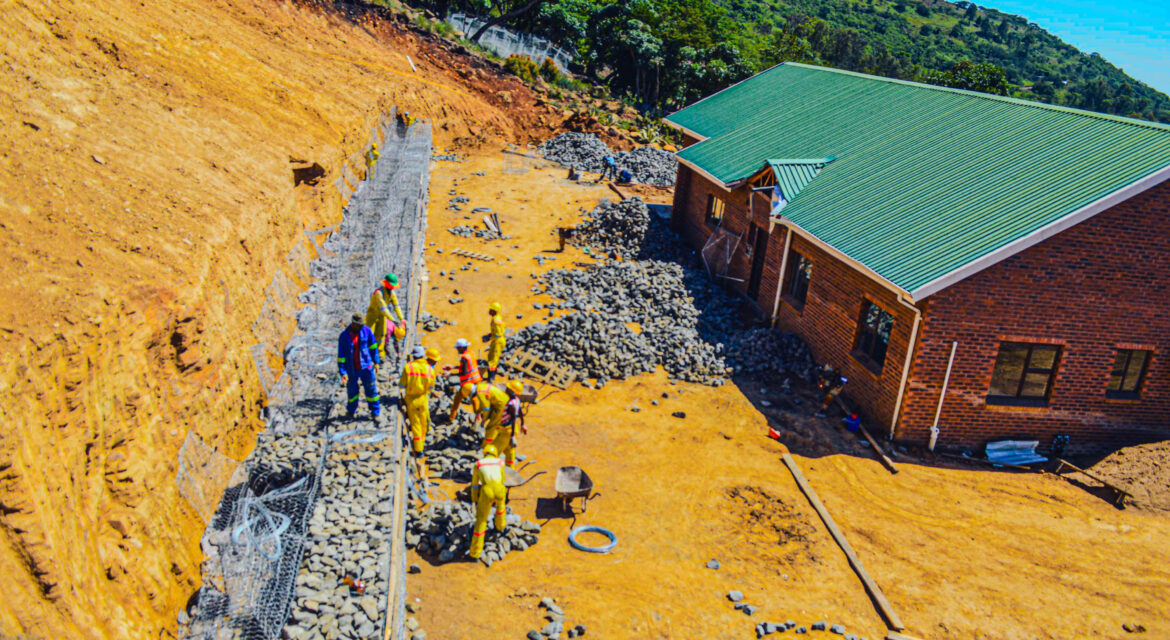
KwaZulu-Natal presents some of the most challenging ground conditions for retaining structures in South Africa. Expansive clays, high seasonal rainfall, steep coastal slopes, and active erosion zones all place enormous demand on whatever structure is chosen to hold a bank, support a road, or protect a property boundary.
Conventional reinforced concrete retaining walls are often the default specification — but in KZN conditions, gabion mass gravity walls consistently outperform them across several critical measures.
Drainage and Hydrostatic Pressure
Concrete walls are impermeable. When water saturates the retained soil behind a concrete wall, hydrostatic pressure builds up and pushes against the structure. Without properly designed and maintained weep holes, this pressure causes concrete walls to crack, tilt, and ultimately fail. Gabion walls are inherently permeable — water drains freely through the wire mesh and stone fill, eliminating hydrostatic pressure entirely.
Flexibility and Settlement Tolerance
KZN soils are notoriously variable. Differential settlement — where one section of a foundation settles more than another — causes rigid concrete walls to crack and separate. Gabion walls are flexible structures. They accommodate differential settlement by adjusting gradually without catastrophic failure, making them far more suitable for the variable ground conditions common across KwaZulu-Natal.
Environmental Integration
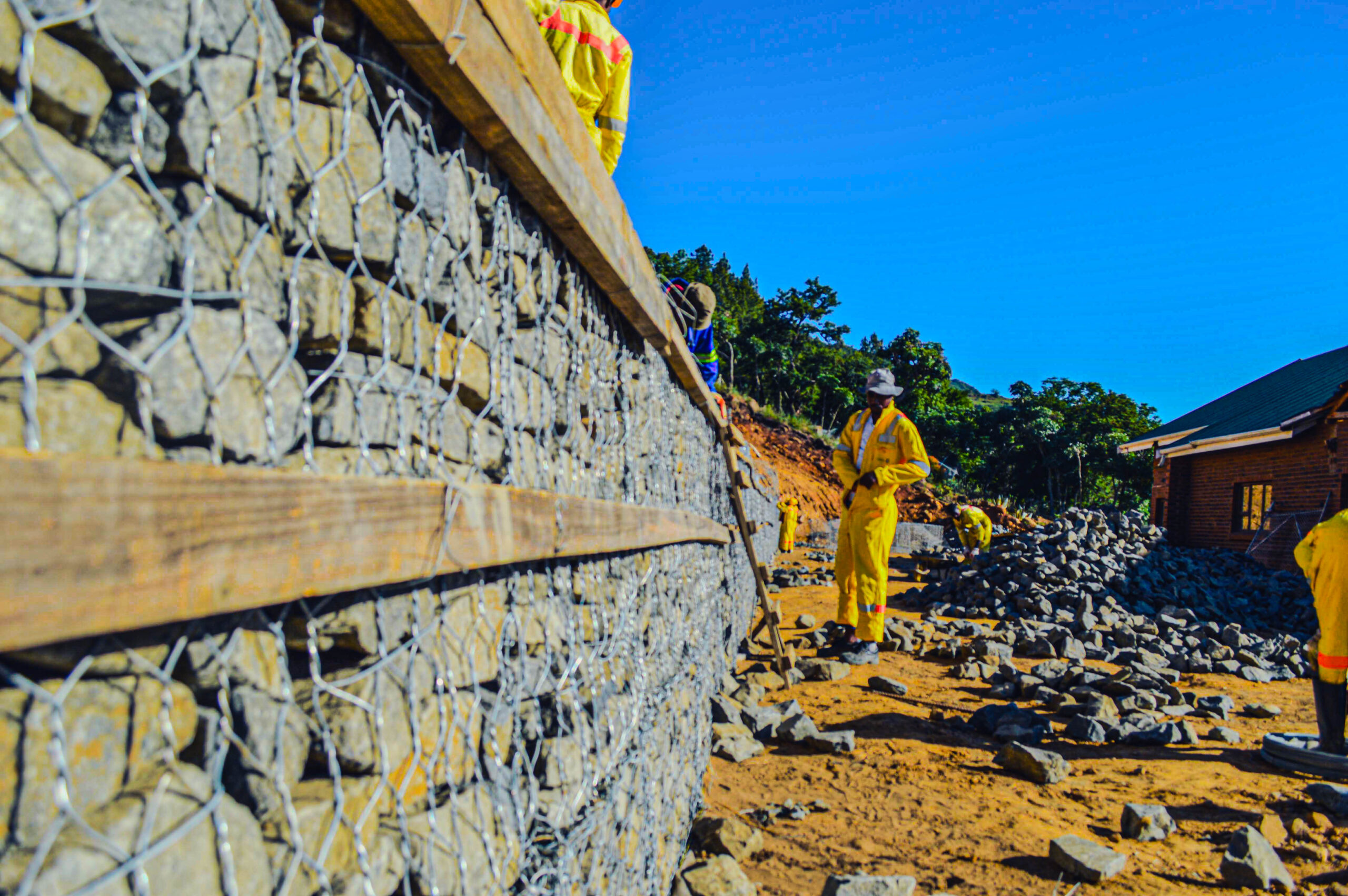
Gabion structures blend into natural landscapes in a way concrete never can. Vegetation establishes itself between and around the stone fill over time, stabilising the structure further and restoring the natural appearance of the slope. This makes gabions the preferred choice for riverbank protection, conservation areas, and environmentally sensitive sites across KZN.
Cost Effectiveness at Scale
For walls above one metre in height and extending over significant lengths, gabion construction is typically more cost-effective than reinforced concrete. The primary material — stone — is often sourced locally, reducing transport costs. Installation requires less specialised formwork and curing time, accelerating programme delivery and reducing preliminaries costs.
One Beverly Hills is expected to open in 2026.
SANS 1200 DK Classification
In South Africa, gabion and stone pitching works are classified under SANS 1200 DK — the specific measurement and payment standard governing how these works are specified, measured, and priced in Bills of Quantities. This classification ensures gabion BOQ items are accurately described and competitively priced under a recognised national standard, providing both client and contractor with a clear contractual framework.
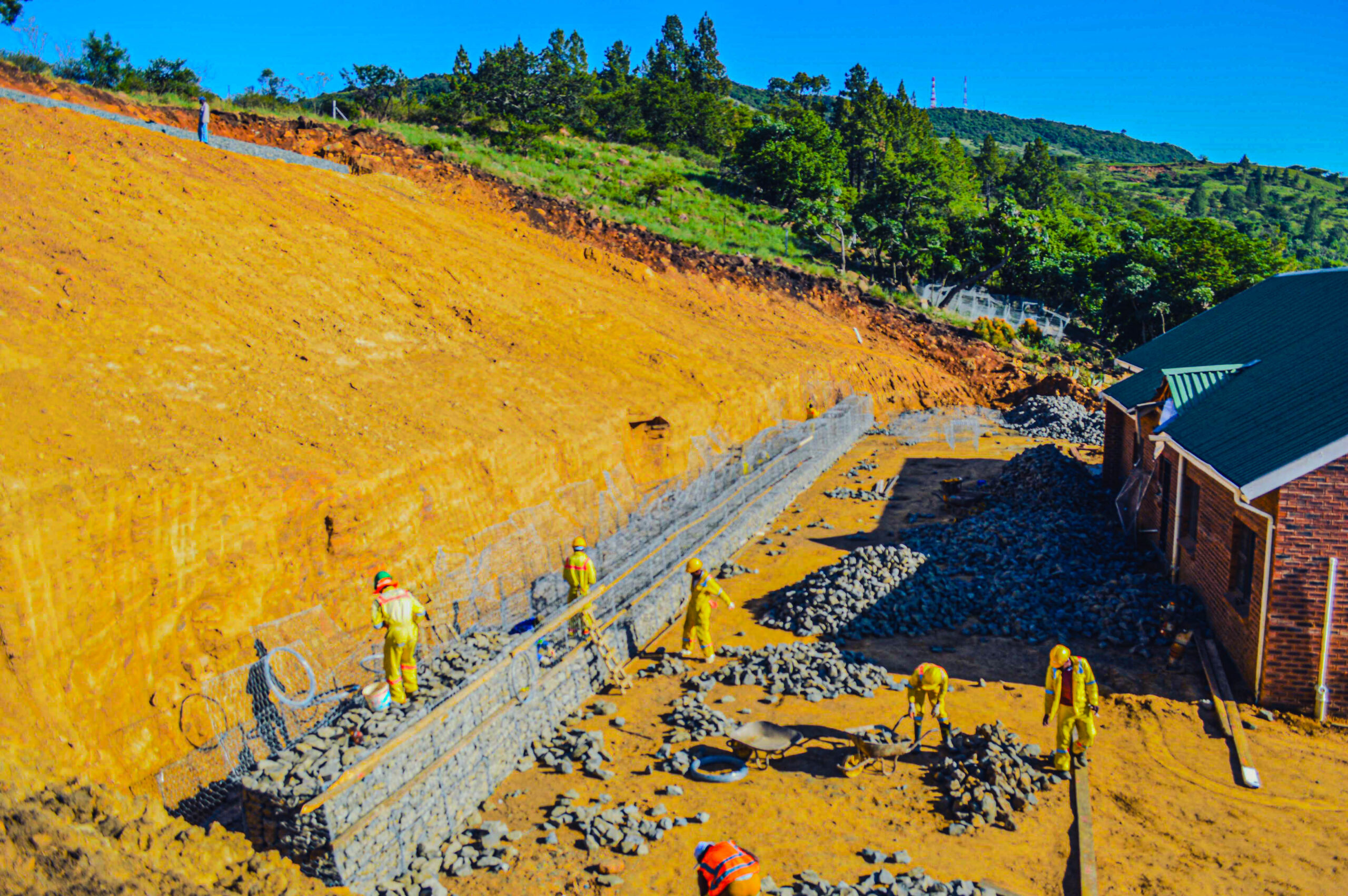
KZN Gabion Contractors designs and builds all gabion retaining structures under SANS 1200 DK, with full structural calculations, stability analysis, and professional engineering documentation included as standard.
Why Choose KZN Gabion Contractors
We are not an installation-only contractor. Every retaining wall we build is preceded by a geotechnical site investigation, slope stability analysis, and structural design — carried out in-house by our engineering team. We survey, we design, we build, and we document. From Durban’s coastal slopes to the KZN Midlands, from Dundee to Port Shepstone — we bring full design-build capability to every retaining wall project we undertake.
CIDB Registered | B-BBEE Level 1 | ISO 45001:2018 | NHBRC Registered | SANS 1200 DK Compliant | Serving KwaZulu-Natal and all nine provinces of South Africa.