When a retaining wall needs to rise beyond two or three metres, the mass of a conventional gabion gravity wall becomes both its greatest asset and its greatest limitation. To retain greater heights, the wall must grow proportionally wider at its base — consuming significant footprint, requiring more material, and demanding more extensive foundation preparation. On constrained sites where space is limited, this approach quickly becomes impractical.
Mechanically Stabilised Earth — commonly known as MSE — solves this problem by fundamentally changing how the retained soil mass behaves. Instead of relying on the weight of the wall alone to resist the lateral pressure of the soil behind it, MSE systems reinforce the soil itself — transforming it from a destabilising force into a structural component of the wall.
What is TerraMesh
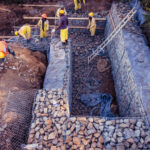
TerraMesh is a mechanically stabilised earth system developed by Maccaferri that combines a gabion wire mesh facing with integral geogrid soil reinforcement layers extending back into the retained fill. The facing units — filled with stone in the same manner as conventional gabion baskets — provide the structural face of the wall and give it the familiar, natural appearance of a gabion structure. Behind the face, layers of geogrid extend horizontally into the compacted fill at regular vertical intervals, anchoring the facing to the retained mass and distributing load across a wide reinforced zone.
The result is a structure that behaves as a coherent reinforced block rather than a simple gravity mass — capable of retaining significantly greater heights within a much smaller footprint than a conventional gravity wall of equivalent retained height.
Engineering Principles Behind MSE
The stability of an MSE wall depends on two mechanisms working together. Internal stability is provided by the friction and interlock between the geogrid reinforcement layers and the compacted fill material — the geogrids prevent the fill from shearing horizontally and pulling away from the face. External stability is provided by the reinforced mass as a whole resisting overturning, sliding, and bearing failure at the foundation level — analysed using the same principles as a conventional gravity retaining wall but applied to a much larger and more stable composite block.
Design of TerraMesh and similar MSE systems requires careful analysis of both mechanisms — geogrid spacing, length, and tensile strength must be selected to match the specific fill material properties, wall height, surcharge loading, and seismic conditions at each site. This is not a system that can be safely specified from a catalogue without site-specific engineering input.
When TerraMesh is the Correct Solution
MSE systems are the appropriate solution when one or more of the following conditions apply. The retained height exceeds what is practical for a conventional gravity gabion wall — typically above three to four metres depending on site conditions. The available footprint at the base of the wall is constrained by existing infrastructure, property boundaries, or site geometry. The founding conditions favour a distributed load over a wider reinforced zone rather than a concentrated load at the toe of a gravity wall. The client requires a structure with a natural stone face finish that integrates with the landscape while delivering the retained height of a more engineered system.
Geosynthetics in MSE Construction
TerraMesh systems use high-tenacity polyester or polypropylene geogrids as the primary reinforcing element. These materials are selected for their long-term creep resistance, durability in the compacted fill environment, and compatibility with the wire mesh facing connections. In addition to the primary geogrid reinforcement, MSE walls typically incorporate a geotextile separation layer between the reinforced fill and any natural ground behind the reinforced zone — preventing migration of fines from the natural soil into the engineered fill and maintaining the drainage performance of the reinforced mass over the long term.
Geosynthetic selection is a critical design decision. Different fill materials, loading conditions, and design lives require different geogrid tensile strengths and geotextile filtration characteristics. Our engineering team specifies geosynthetics based on site-specific testing and design calculations — not generic product defaults.
Our TerraMesh and MSE Capability
KZN Gabion Contractors designs and builds TerraMesh and MSE retaining systems for clients across KwaZulu-Natal and South Africa. Our capability spans the full project lifecycle — from geotechnical investigation and fill material testing through engineering design, geosynthetic specification, earthworks, fill compaction quality control, and facing installation.
We understand that MSE construction quality depends as much on the fill placement and compaction process as on the design itself. Poorly compacted fill behind an MSE wall undermines the friction mechanism that gives the system its structural integrity. Our site supervisors are trained in MSE construction sequencing and compaction control — ensuring that what is built matches what was designed.
Whether your project requires a conventional mass gravity gabion wall, a TerraMesh MSE system, or a hybrid solution combining both approaches, we have the engineering capability and construction experience to deliver the right structure for your specific site conditions.
CIDB Registered | B-BBEE Level 1 | ISO 45001:2018 | NHBRC Registered | SANS 1200 DK Compliant | Serving KwaZulu-Natal and all nine provinces of South Africa.