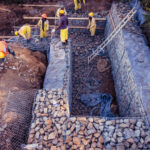
When construction teams carry out bulk earthworks on steep terrain, the exposed surfaces left behind present one of the most difficult rehabilitation challenges in civil engineering. Cutting into a hillside to establish a platform for a structure, a road, or a drainage system frequently exposes raw bedrock — a surface with no topsoil, no organic matter, and no ability to support natural vegetation recovery.
This is exactly the condition we encountered at our Dundee, KwaZulu-Natal project. After completing bulk excavations across multiple sections of the site, several exposed faces were bare rock with zero prospect of natural revegetation. Left untreated, these surfaces would remain permanently exposed — vulnerable to weathering, freeze-thaw cracking, and progressive surface erosion that would eventually undermine the structures built above and below them.
What is a Geocell Honeycomb System
A geocell — also called a honeycomb or modular cellular confinement system — is a three-dimensional expandable panel made from high-density polyethylene strips. When expanded on site, it forms a honeycomb grid of interconnected cells that are filled with growing medium, soil, or aggregate depending on the application.
On vegetated slopes, the cells are filled with a engineered growing medium — a blend of topsoil, compost, and moisture-retaining material — that gives plant roots enough depth and nutrition to establish even on surfaces that would otherwise be completely inhospitable to growth.
Why Geocells Work on Exposed Bedrock
The fundamental problem with revegetating bare rock is that there is nothing for roots to grip and no water retention for seedling establishment. Conventional hydroseeding or topsoil spreading simply washes off steep rock faces in the first rainfall event.
Geocells solve this by mechanically anchoring the growing medium to the rock surface. The cells are pinned directly to the bedrock using steel anchor pins driven into the surface at regular intervals. Once anchored and filled, the honeycomb structure holds the growing medium in place regardless of slope angle or rainfall intensity. Roots penetrate downward through the cell bases, grip the rock surface, and over one to two growing seasons create a self-sustaining vegetated mat that requires no further intervention.
Environmental and Engineering Benefits
The integration of geocell revegetation with gabion retaining structures creates a combined hard and soft engineering solution that outperforms either approach used alone. The gabion structure provides immediate structural stability and erosion resistance. The geocell revegetation progressively transfers load-bearing and erosion-control function to the established root system over time — reducing long-term maintenance requirements and enhancing the ecological value of the site.
From a client perspective, this approach also satisfies environmental compliance requirements that increasingly form part of construction contracts under South African environmental legislation — particularly where works occur near watercourses, in conservation buffer zones, or on sites requiring environmental authorisation.
Our Dundee Application
At our Dundee project we installed geocell honeycomb panels across exposed bedrock faces adjacent to the gabion retaining walls and rockfall barrier structures. Anchor pins were driven into the rock, panels were expanded and pinned in place, cells were filled with engineered growing medium, and the surfaces were hydroseeded with a locally appropriate grass and pioneer species mix suited to KZN midlands conditions.
Within one growing season the surfaces had achieved substantial cover — permanently stabilising faces that would otherwise have remained bare rock indefinitely.
Green Engineering as Standard Practice
KZN Gabion Contractors integrates green engineering solutions as standard practice on all projects where exposed surfaces require rehabilitation. We do not treat revegetation as an afterthought or a separate subcontract. It is designed into the project from the outset — specified, costed in the BOQ, and executed by our own team.
This approach reflects our commitment to delivering structures that perform not only structurally but environmentally — leaving sites in better condition than we found them.
CIDB Registered | B-BBEE Level 1 | ISO 45001:2018 | NHBRC Registered | Serving KwaZulu-Natal and all nine provinces of South Africa.