Water is the most powerful and persistent force acting on civil infrastructure in South Africa. Rivers undercut banks, stormwater scours channels, flood events destroy unprotected structures, and even moderate rainfall accelerates erosion on unlined drainage lines. Managing water effectively — directing it, slowing it, containing it, and dissipating its energy safely — is one of the most technically demanding disciplines in civil engineering.
Gabions are uniquely suited to hydraulic applications. Their permeability, mass, flexibility, and resistance to scour make them the preferred material for a wide range of water management structures across KwaZulu-Natal and South Africa.
River Bank Revetments
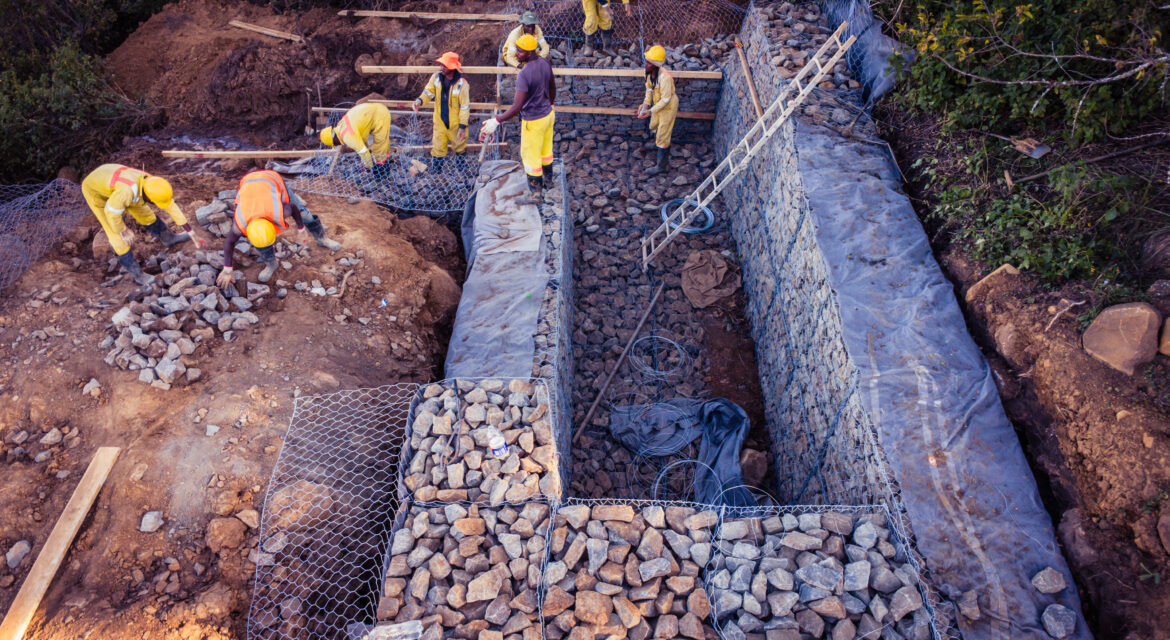
A river bank revetment is a protective facing installed along a natural or engineered river bank to resist erosion from flowing water. Gabion revetments are designed to absorb and deflect the energy of flowing water without rigid cracking or catastrophic failure. Unlike concrete bank lining, gabion revetments flex with seasonal bank movement, allow groundwater to drain freely, and integrate with natural vegetation over time — progressively strengthening the bank rather than fighting against natural processes.
We design river bank revetments based on hydraulic analysis of the specific watercourse — flow velocity, flood return period, bank geometry, and soil conditions all inform the final design. A revetment sized for a 1-in-10-year flood event performs very differently from one designed for a 1-in-50-year event, and the difference matters enormously on high-value infrastructure corridors.
Groins and River Training Structures
A groin — sometimes called a spur or jetty — is a structure that projects from the river bank into the channel, deflecting river flow away from a vulnerable bank section or directing it toward the centre of the channel. Groins are among the most effective and cost-efficient tools in river management, protecting long sections of bank by influencing how the river moves rather than simply armoring every exposed surface.
We design and build gabion groins for river training projects, flood protection works, and erosion control along KZN’s major and minor watercourses. The permeable nature of gabion groins allows water to filter through the structure while still deflecting the primary flow — reducing scour at the groin toe and extending the working life of the structure.
Energy Dissipation Structures
Wherever water drops from a higher elevation to a lower one — at culvert outlets, dam spillways, canal drops, and stormwater chutes — the kinetic energy of the falling water must be safely absorbed before it re-enters the natural channel. Without a properly designed dissipation structure, this energy scours the channel bed and banks immediately downstream, progressively undermining the outlet structure itself and threatening everything downstream.
Gabion stilling basins, plunge pool linings, and apron protection structures are designed to absorb this energy through turbulence within the permeable stone fill — dissipating velocity safely before water returns to the natural channel. We design all dissipation structures using hydraulic calculations based on the specific flow conditions at each site, ensuring the structure is correctly sized for both normal flow and flood events.
Check Dams and Drop Structures
In eroding drainage lines, watercourses, and agricultural channels, head-cutting — the progressive upstream erosion of the channel bed — is one of the most destructive processes affecting rural and peri-urban land across KwaZulu-Natal. Once head-cutting begins it accelerates, consuming productive land and undermining roads, fences, and structures as it progresses upstream.
Gabion check dams arrest head-cutting by re-establishing grade control at specific points along the channel. Water drops over the check dam, its energy is dissipated in the plunge pool below, and the channel bed stabilises upstream of each structure. A series of check dams spaced at calculated intervals can rehabilitate an entire eroding drainage system — permanently arresting a process that would otherwise continue indefinitely.
Gabion Weirs
Low-head gabion weirs are used for flow measurement, water diversion into irrigation systems, groundwater recharge, and habitat management in rivers and streams. Their permeable construction allows fish passage and maintains ecological connectivity along watercourses — an important consideration under South African environmental legislation governing works in and adjacent to watercourses.
Detention and Retention Bunds
On agricultural and peri-urban sites, gabion bunds and low-head detention structures are used for stormwater detention — slowing the release of runoff from developed areas, reducing peak flood flows, and allowing sediment to settle before water re-enters natural drainage systems. These structures also contribute to groundwater recharge, extending the availability of water in the dry season on agricultural properties.
Our Hydraulic Engineering Capability
Every hydraulic gabion structure we design and build is preceded by a site-specific hydraulic assessment. We analyse catchment areas, calculate design flood flows, model flow velocities, and determine the correct structure type, size, founding depth, and protection requirements before a single gabion unit is placed.
This engineering-first approach is what separates our hydraulic structures from those that fail within seasons of installation. A gabion weir built without hydraulic analysis is guesswork. A gabion revetment sized from a catalogue without site-specific flow data is a temporary measure at best.
We bring the same engineering rigour to a farm drainage line in the KZN Midlands as we bring to a major river training project — because every structure we put our name on must perform for decades, not seasons.
CIDB Registered | B-BBEE Level 1 | ISO 45001:2018 | NHBRC Registered | SANS 1200 DK Compliant | Serving KwaZulu-Natal and all nine provinces of South Africa.